

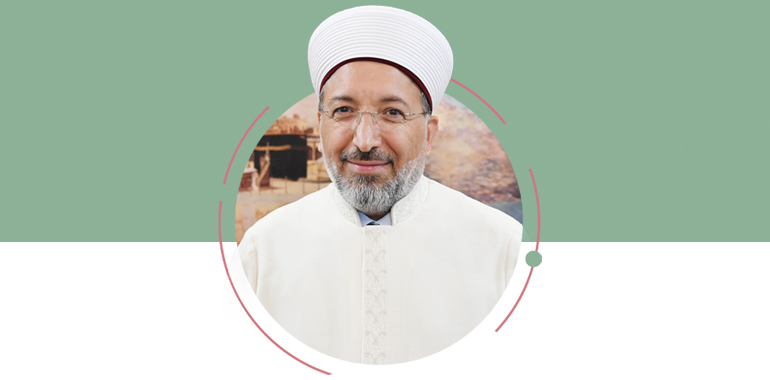
He graduated from Marmara University, Faculty of Theology, in 1990. Arpagus began his academic career at the same faculty in 1992 as a research assistant. He completed his master’s degree in 1994 and his doctoral studies in 2001. He was awarded the title of associate professor in 2008 and became a full professor in 2014. Between 2011 and 2021, he served as the vice dean of the Faculty of Theology at Marmara University. He was later appointed as the Mufti of Istanbul and held this position from 2021 to 2025. On September 18, 2025, he was appointed President of the Presidency of Religious Affairs, becoming the 19th person to hold this office. His academic field of study is the history of Islamic Sufism, including Sufi concepts and institutions. Arpagus has especially focused on Mawlana Jalal al-Din Rumi, the Mathnawi, and the Mawlawi Order and has published numerous books, articles, and translations on these subjects.
In the Noble Qur’an, Allah the Almighty states, “We have sent you (O Prophet) only as a mercy for the whole world” (Anbiya, 21:107). From the perspective of this universal truth, how should the Prophet Muhammad’s being a mercy to the worlds be contemplated and understood?
First of all, I would like to point out that the concept of mercy mentioned here refers to the mercy of our Exalted Lord toward all of creation. As you are well aware, the Noble Qur’an introduces our Lord to us with the names “ar Rahman” and “ar-Rahim”. Allah is ar-Rahman and ar-Rahim—the One Who shows mercy to all creatures and bestows countless blessings upon them. That is why we begin all our affairs by invoking these exalted names that express Allah’s infinite mercy. We seek refuge in His boundless mercy and vast compassion. Indeed, Allah the Almighty emphasizes the limitless nature of His mercy with the verse: “But My mercy encompasses everything.” (A‘raf, 7:156)
There are, of course, countless manifestations of our Lord’s mercy upon His servants. One of the clearest expressions of Allah’s mercy toward humanity is His sending of revelation to convey the truth and appointing prophets to deliver the truths of that revelation to His servants. Indeed, for a person to comprehend the truth and to maintain sound and healthy relationships with their Lord, with themselves, and with their surroundings, it is only possible through the guidance of revelation and the prophets. In this context, the final prophet, Prophet Muhammad (saw), through the divine message he brought and the guidance he exemplified, reunited humanity—lost in the darkness of ignorance— with knowledge, wisdom, and understanding, leading them from darkness into light through the guidance of revelation. The truths brought by the Prophet Muhammad have illuminated the path and horizon of all humanity. His approach toward human beings, nature, and all living creatures has established a timeless example for all of humankind. Indeed, his coming has been a mercy to the entire realm of existence. Indeed, the verse you mentioned in your question, in which Allah the Almighty introduces the Prophet to us, expresses that the Prophet Muhammad was not sent as a mercy solely to those who directly received the revelation, but rather as a mercy to all of humanity, and even to the entire realm of existence. The Prophet Muhammad brought forth universal principles that show the paths to justice, mercy, trust, and a balanced life upon righteousness on earth. Realizing these principles will serve as a means of humanity’s salvation. A consciousness built upon this foundation, along with a worldview shaped by these values, will also be a mercy to the entire realm of existence.
When we look at the life of the Prophet Muhammad, it becomes clear that his mercy was not merely a felt emotion or an abstract virtue, but a concrete mode of conduct and a way of life. What fundamental moral messages does this noble stance and exalted character offer to human beings, who have been swept into a whirlpool of speed, comfort, and self-centeredness amid the chaos of the contemporary age?
Certainly, “mercy” is by no means merely an abstract virtue, a purely felt emotion in the heart, or a philosophical concept. Mercy, which is a reflection of Allah the Almighty’s name “ar-Rahman”, has not only an inner, spiritual dimension but also a practical, actionable aspect. Mercy revives, expands, and beautifies the heart in which it takes root, transforming all of a person’s words, attitudes, and behaviors into manifestations of divine mercy. In this regard, mercy is one of the most fundamental values that gives life to a person and imparts a humane, conscientious, and moral integrity to their life. As Mawlana said: “Mercy is a water of life within existence. Whoever lacks mercy is but a dead soul.”
The most beautiful example for us in reflecting the feeling of mercy into life is our beloved Prophet. For all the truths, principles, and moral values of Islam were exemplified in the most perfect manner by the Prophet Muhammad, transforming them into a model way of life. He taught us every truth of the Qur’an by living it. For this reason, we regard every moment of the Prophet’s life as a divine blessing granted to us by our Lord. We believe that the peace and salvation of all humanity lie in taking his life as an example. Mercy stood at the very center of his view of life. He linked being deserving of Allah’s mercy to showing mercy toward creation. He said, “Allah shows mercy to those who are merciful; show mercy to those on the earth so that those in the heavens will show mercy to you.” (Abu Dawud, Adab, 58).
He himself treated every creature with the utmost compassion and mercy. His mercy, especially toward the believers, was evident in every moment of his life. Even in times when he did not have enough means at home for himself and his family, he still helped those in need and extended a hand to the poor, no matter the cost. With Allah’s mercy, he treated all people with kindness and was never harsh, severe, or hurtful toward anyone. He bore no feelings of revenge against anyone, remained patient in the face of people’s rudeness and mistakes, and chose the path of forgiveness and tolerance. He showed mercy even to his enemies; even when they launched the harshest attacks against him, he never cursed them; instead, he prayed for their forgiveness. Therefore, in the life of the Prophet Muhammad, mercy goes beyond being merely a feeling; it represents sacrificial action and embodies attitudes and behaviors demonstrated for the well-being of all living beings.
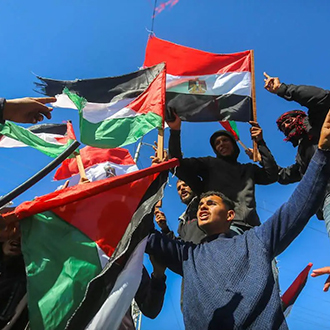
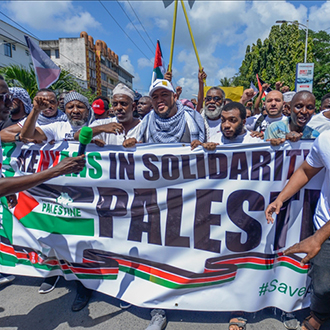
Today, modern human beings, caught in a whirlpool of pleasure, speed, and self centeredness, have drifted away from mercy and, as a result, have become distant from empathizing with others and sharing in their pain. The ability to remain indifferent while people nearby suffer from hunger, deprivation, and poverty is one of the clearest signs of this. Likewise, the fact that one can watch the unjust killing of thousands of people in live broadcasts and continue with life as if nothing has happened, without even feeling a trace of sorrow in the heart, is a reflection of this absence of mercy.
The attitude of the Prophet Muhammad (saw) in his family life, rooted in love, respect, justice, and mercy, presented the finest examples of human relationships. This prophetic approach, especially notable for its ethics of family communication, offers what spiritual remedies for today’s rapidly deteriorating and fragmented family structure?
Values such as love, respect, justice, fairness, and mercy form the very soul of human relationships. However, in the modern age, pragmatic approaches, almost enslaving the individual, have led to relationships often unfolding devoid of these essential values. Human interactions today are conducted in an environment dominated by individualism and selfishness, where mutual consideration is lacking, the ethics of living together are neglected, spiritual values are pushed aside, and selflessness is seen as meaningless. When justice ceases to be the guiding principle in relationships and hearts are deprived of mercy, words, attitudes, and behaviors become driven by anger, hatred, and unchecked desires. The family is the institution that suffers the most from this decline. As a result, in the modern age, the family institution is increasingly damaged and worn down with each passing day, gradually losing its quality as a haven of peace and security. The cure for this ailment, which wounds the institution of the family and threatens social harmony, undoubtedly lies within the family life of the Prophet of Mercy. Today, both building a strong family structure and restoring the family unit worn down by the turmoil of modern life can only be achieved by following the example of the Prophet Muhammad. In this regard, we know that love, respect, and mercy always held a central place in his family life. The Messenger of Allah always valued his family members, especially his wives, paid utmost attention to their rights, consulted with them, and never withheld his support in managing their affairs. At times, he would even joke with them, race with them, and spend pleasant, joyful moments together. He showed love and compassion, especially toward children; he kissed his grandchildren, embraced them, and played with them. Even during acts of worship, he made an effort to keep their hearts content. The hadith that expresses all of this, “The best of you is the one who is best to his family, and I am the best among you to my family” (Ibn Majah, Nikah, 56), is undoubtedly the most beautiful prescription for family life.
What spiritual values and principles should we prioritize today in order to rebuild our workplaces, homes, and schools—in short, our entire society— upon the climate of mercy and the foundations of love and justice, as taught by the Prophet Muhammad?
In fact, the subjects we have been discussing from the beginning, centered on love, respect, justice, and mercy, constitute the essential steps for establishing a society grounded in these values. The Prophet Muhammad taught us the practical implementation of such a society step by step through his own life and built a civilization of mercy that serves as an example for all of humanity. Of course, being the ummah of the Prophet of Mercy also brings with it a great responsibility. In order to establish a society of mercy as the Prophet Muhammad once did, we must bring his example into our lives in all its dimensions. In this context, it is essential to raise individuals with love, compassion, and mercy, first and foremost by loving all of creation for the sake of the Creator, and to weave a Muslim identity, thread by thread, with these values. As you know, love, compassion, and mercy possess a healing power for both individuals and society. Moreover, without a doubt, the most suitable and primary environment for sowing and nurturing the seeds of love, compassion, and mercy in hearts is the family home. It is essential to build the family, which is a place of education, upon these foundations, to shape the character of those raised within it according to the noble moral principles of Islam, and to imbue their souls with these universal values. In this regard, great responsibilities also fall upon our educational institutions and educators. All of Islam’s life-giving values and principle must be instilled in the minds and hearts of future generations with the precision of a jeweler. Individuals who are raised, both within the family environment and in schools, by experiencing goodness, love, respect, and the feeling of mercy will naturally adopt these traits as a way of life. While this is the most fundamental responsibility for every Muslim, it is also a vital and effective method for transforming mercy into lived practice. Indeed, the first generation that was raised under the guidance of the Prophet Muhammad through such practices formed the very essence and foundation of the civilization of mercy. Outstanding examples, such as those who would leave food on mountaintops during harsh winter seasons so that wild animals could survive, emerged from this very spirit of mercy.
In the face of today’s global challenges, where should a believer who wishes to reflect the character and example of the Prophet Muhammad begin, and which fundamental principles should they adopt as their compass?
Let me emphasize that in the face of today’s global challenges, which undermine, disregard, and dismantle established values, what truly matters is not merely speaking about the Prophet Muhammad, but reflecting the principles he established and the exemplary character he embodied in our own lives. It is to adopt a stance befitting a believer. In fact, the entire world is in need of such a stance. In today’s world, where the vast majority of humanity is experiencing extremely difficult times due to the insatiable greed, avarice, and selfishness of those who have forgotten justice and mercy, humanity is in dire need of such a stance. The need for Islam’s vision of life, its understanding of justice, and its moral principles, embodied in the example of the Prophet Muhammad, who was sent as a mercy to the worlds, is being felt more and more with each passing day. Today, humanity seems to have, regrettably, forgotten mercy and justice. As it grows distant from mercy, it becomes trapped in a dark and barren climate. Because these principles have been abandoned—especially by Muslim societies, but also by humanity as a whole— people are now suffering from injustice, unrest, and spiritual crises. As a result, episodes of violence, anger, hatred, and unchecked desire have descended upon the modern world like a nightmare. The earth has become a place increasingly overtaken by injustice, inequality, hunger, and poverty. In such a context, it is of great importance that the exemplary life of the Prophet Muhammad be properly understood and that the values he brought be represented in the most beautiful manner and conveyed to humanity. This suffocating darkness that weighs upon the soul can only be dispelled by making the message of mercy brought by our exalted religion, Islam, prevail in our lives, through the example of the Prophet Muhammad. In this regard, the first step is to strengthen the feeling of mercy within our hearts and place it at the very center of our lives. We must reflect the example of the Prophet of Mercy— rooted in knowledge, wisdom, justice, and compassion—in our words, attitudes, and actions; to live it fully and strive to keep it alive. By doing so, despite the self-interest driven global challenges of the modern age, goodness and mercy will prevail, and the climate of peace will replace the cycles of violence and whirlpools of hatred that have long afflicted humanity.