The 16th century was a time when powerful seafarers and colonial powers began to appear on the horizon of the world. The Portuguese, in particular, dreamed of establishing a vast global colonial empire. Gradually, they began settling along the coasts of Arabia, India, and Malaya. For the Muslims of the region, who were subjected to colonial assaults, there was only one place to turn to and seek help: The Ottoman Empire and its mighty sultan, Sultan Suleiman the Magnificent!
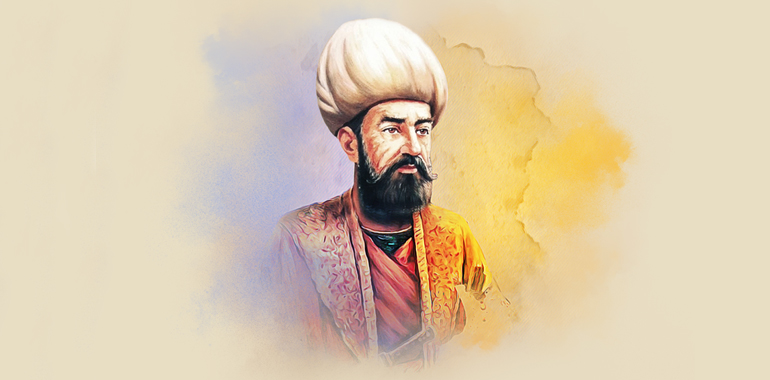
The Ottoman Empire heeded the call of the distant Muslims and promptly established a new military unit: The Indian Ocean Command. In 1547, an admiral named Piri Reis was appointed as the head of this new unit. He would go on to become one of the most distinguished figures in Islamic history.
An elegant man
Piri Reis was originally Turkish from Karaman. He was born between 1465 and 1470 in Gallipoli, a small coastal town known at the time as a Turkish naval base. His father was Haji Mehmed.
The renowned Turkish historian of the period, Ibn Kemal, described the children born in Gallipoli at that time with the following words: “Children born in Gallipoli grow up in the water like crocodiles. Their cradles are vessels of death. They fall asleep to the lullaby of ships’ sounds, morning and evening.” Muhiddin Piri, the future great seafarer who grew up under this metaphor, lived in the charming coastal town of Gallipoli until the age of eleven. He was raised under the guidance of his uncle, Kemal Reis, one of the most prominent Turkish captains of the era. There was not a single coast, port, or island in the Mediterranean that he had not visited. As a result of these expeditions, he earned the title of captain by the age of twenty-five. He was also honored with the duty of delivering the news of the conquest of Navarino from the Venetians to Istanbul.
The figures from whom Piri Reis learned seamanship were among the most renowned sailors of the 16th century. After the death of his uncle, Kemal Reis, who drowned when his ship sank off the coast of Gallipoli, he served under Aruj Barbarossa (Oruc Reis) and later under Hayreddin Barbarossa (Hizir Reis). He also took part in the conquest of Egypt.
When Makbul (Pargali) Ibrahim Pasha, the most powerful statesman of the reign of Sultan Suleiman the Magnificent, set out to inspect Egypt, the captain of the ship he boarded was Piri Reis. During this journey, the Pasha was deeply impressed by Piri Reis’s knowledge and intellect, and subsequently appointed him as an advisor. Upon returning, he spoke highly of him to Sultan Suleiman and offered considerable praise. As Piri Reis’s brilliance in his field was quickly recognized, he was appointed as the Indian Ocean Commander in 1547.
Indeed, the most powerful Turkish admiral of the era, Barbaros Hayreddin Pasha, described Piri Reis in his book Gazavat-ı Hayreddin Pasha, a kind of memoir dictated to Muradi, as “a man of great understanding, refined manners, and well versed in the customs and protocols of the courts of high officials.”
The most accurate map
Piri Reis, one of the most important figures of the golden age of Sultan Suleiman the Magnificent, was a scholar of geography and cartography. He is best known for his geographical work Kitab-ı Bahriye (The Book of the Sea) and his two world maps dated 1513 and 1528, which left all who saw them in awe. Completed in 1521, Kitab-ı Bahriye is a book composed of hundreds of maps detailing the Mediterranean and its islands with remarkable precision. The introduction section was written in poetic form by Muradi, based on the words of Piri Reis himself. Piri Reis also drew a map of the Atlantic Ocean, which was unfamiliar territory for the people of his time. By charting the coasts from Greenland to Florida, he included references to the newly discovered American continent and confirmed that the Earth is round. Experts in the field have remarked that the map of Europe he produced was even more accurate than the one drawn by Europeans in 1528.
The first world map of Piri Reis
The works that made Piri Reis’s name known to nearly everyone are the two world maps he drew. The first of these was created in 1513 and presented to Sultan Selim I in Egypt in 1517. Of course, Piri Reis’s map was not the first world map in history. Before him, many cartographers had produced maps based on the known regions of the world at the time. According to the most plausible interpretation, Piri Reis had seen Columbus’s map and, by consulting other maps as well, produced his own. This map, colored using nine different pigments, was drawn on leather and measures 86 cm in height, with a width of 61 cm at the top and 41 cm at the bottom. It represents a portion of a complete world map. The map features wind roses and various directional lines. The names of the locations marked on the map are accompanied by descriptions of their characteristics and notes on who discovered them.
The second world map of Piri Reis
The second map that Piri Reis presented to Sultan Suleiman the Magnificent in 1528 was drawn on gazelle skin and colored using eight pigments. It represents only the northwestern corner of a larger world map. This section includes the northern Atlantic Ocean, the newly discovered coasts of North and Central America, and the shoreline stretching from Greenland to Florida. The fact that Piri Reis corrected the inaccuracies from his first map, caused by incomplete information, demonstrates his rigorous scientific approach and attentiveness to ongoing developments. This second map, produced on a larger scale and with greater precision than the first, stands as one of the most advanced cartographic works of its time.
Piri Reis’ description of the American continent
Piri Reis described both the discovery of America and its native inhabitants as follows: “My late uncle Gazi Kemal had a Spanish servant. This slave claimed, ‘I traveled to those lands three times with Columbus,’ and recounted the events as follows: The island’s people came and showered them with arrows. Both men and women fired arrows—they were all naked. When the crew could not land, they moved their ships to the other side of the island and anchored there. The islanders, realizing that no harm was coming from these ships, approached them and began bringing fish in their small boats. The crew welcomed them kindly and gave them glass beads in return. It turns out Columbus had read in a book that glass beads were considered valuable in that region. When the natives saw the beads, they brought more fish. The crew continued to give them glass beads in exchange. One day, they saw a woman wearing gold on her arm. They took the gold and gave her beads. Then Columbus’s men said, ‘Bring more gold, and we will give you more beads.’ The islanders returned with even more gold. From these islands, they also took a large quantity of red dye wood and brought back two of the islanders to present to the king of Spain that same year. Now, those lands have been completely opened and have become widely known.”
Demise of Piri Reis
The second Egyptian expedition in 1552 marked a tragic turning point for both Piri Reis and Turkish history. When Piri Reis left the fleet in Basra, intending to allow the ships to undergo maintenance and the soldiers to rest, while he sailed to Egypt with ships laden with spoils, political rivalry came into play. Due to the actions of his rivals among the state officials, he was reported to the Sultan for this decision. Found at fault, he was executed in 1554 at a time when he was over 80 years old.