The word “yatim” (orphan) in Arabic means “being alone and lonely”. It also means “the one who walks slowly and lags behind”. An orphan is a child who has lost his or her father and grows up sometimes with the support of the mother and relatives, and at other times with the support of the state. The orphans are entrusted to society. This trust is so delicate and weighty that the verses revealed during the early years of Islam reminds believers about the rights of orphans: “Absolutely not! In fact, you are not (even) gracious to the orphan.” (Fajr, 89:17) “So do not oppress the orphan.” (Duha, 93:9) “Have you seen the one who denies the ‘final’ Judgment? That is the one who repulses the orphan, and does not encourage the feeding of the poor. ” (Ma’un, 107:1-3)
The Holy Qur’an reminds our beloved Prophet, who lost his father before he was born, of the mercy of Allah (swt): “Did He not find you as an orphan then sheltered you?” (Duha, 93:6) This sensitivity about orphans finds its place in the expressions of the Messenger of Allah (saw) as well. The Messenger of Allah’s invitation to his Companions (ra), by showing them his middle and index fingers and the distance between them, is still in front of our eyes: “I and the one who looks after an orphan will be (together) like this in Paradise.” (B5304, Bukhari, Talaq, 25) Our Prophet is telling us that those who take care of an orphan and share their food with them in this world will be with him (saw) in Paradise. A prophet, who was an orphan himself, would instinctively think and care for other orphans.
The Messenger of Allah (saw) did not forget about the mothers who, against all odds, took good care of their fatherless children, and sacrificed a lot for them: “I and a woman whose cheeks have become black (due to hardships) shall on the Day of Resurrection be (together) like these two (pointing to the middle and forefinger). She, who is a woman of rank and beauty who has been bereft of her husband, devotes herself (without getting married) to her fatherless children until they go their separate ways or die.” (D5149, Abu Dawud, Adab, 120, 121) Indeed, who would understand the needs of orphans better than the Messenger of Allah (saw), who himself was an orphan?
To a man who was complaining about his tough and grumpy personality, our Prophet (saw) said, “Pat the heads of the orphans and feed the poor” (HM9006, Ibn Hanbal, II, 387). Patting the head of an orphan means not only to show love and compassion to them, but also to help them to survive in this difficult world. In this regard, the Prophet (saw) gave the good news to those who took care of orphans that they would go to the paradise: “Whoever takes in an orphan among the Muslims to raise, to feed and to give him drink, Allah, without a doubt, admits him into Paradise, unless he has done a sin for which he is not forgiven.” (T1917, Tirmidhi, Birr, 14) The Holy Qur’an also refers to those who share their belongings with orphans as virtuous people (Baqarah, 2:177). ‘Abd Allah b. ‘Umar (ra) never had a meal without having an orphan at his table (EM136, Bukhari, Adab al-Mufrad, 60). This is because he was educated by the Prophet (saw) himself, and his behavior serves as a model for us. By saying, “The best house among the Muslims is a house in which there is an orphan who is treated well and the worst house among the Muslims is a house in which there is an orphan who is treated badly,” (M3679, Ibn Majah, Adab, 6) the Messenger of Allah (saw) demonstrated to us that the treatment of orphans is one of the main and important criteria for a household to be labeled a good or bad home.
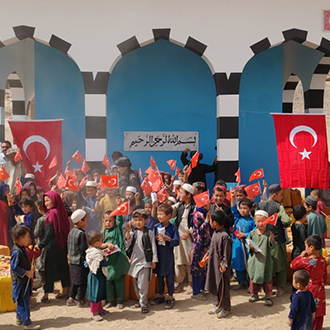
It is clear from the sources above that orphans have priority in the Islamic tradition. These orphans may be the children of martyrs, others may have lost their parents to illnesses or accidents, and some may have lost their parents to devastating wars, which destroy our material and spiritual worlds. The main point is that they are no longer with their parents. They need special care, more than anyone else. They all wish to be like Anas (ra), who was taken care of by the Prophet (saw). They, like the orphans next to Umm al-Darda’ ra, expect to hear glad tidings from the Messenger of Allah (saw), and receive attention and compassion from Muslims. Taking care of orphans is not only a matter of generosity but also a matter of responsibility for wealthy and able people. The Prophet (saw) explained this responsibility by reciting the following verse: “Righteousness is not in turning your faces towards the east or the west. Rather, the righteous are those who believe in Allah, the Last Day, the angels, the Books, and the prophets; who give charity out of their cherished wealth to relatives, orphans, the poor, (needy) travellers, beggars, and for freeing captives; who establish prayer, pay alms-tax, and keep the pledges they make; and who are patient in times of suffering, adversity, and in (the heat of) battle. It is they who are true (in faith), and it is they who are mindful (of Allah).” (Baqarah, 2:177)
Indeed, the Messenger of Allah (saw) said: “O Allah, bear witness that I have issued a warning concerning (failure to fulfill) the rights of the two weak ones: orphans and women.” (IM3678, Ibn Majah, Adab, 6; HM9664, Ibn Hanbal, II, 440) It is important to be the father or mother to an orphan in every sense. Being a guarantor is a multi-dimensional responsibility. In this regard, one needs to protect the property of the orphan and make sure not to harm it. One also needs to be vigilant against all kinds of things that may harm the property. For example, it is reported that the Messenger of Allah (saw) warned Abu Dharr (ra) not to take responsibility for orphans’ property, because he was not competent in financial matters (M4720, Muslim, Imara, 17; D2868, Abu Dawud, Wasaya, 4). To secure the future of an orphan, the Messenger of Allah (saw) asked the custodian of the orphan’s property to do business with the property so that it would increase in value, rather than lose value. Our Prophet said, “As for one who is the guardian of an orphan who has wealth, then let him do business with it and not leave it until it becomes consumed by charity” (T641, Tirmidhi, Zakat, 15). The Companions took this advice very seriously and followed it as a principle in life. For example, the Caliph ‘Umar (ra) constantly emphasized doing business with the property of orphans (MU592, Muwatta’, Zakat, 6). It is also known that ‘Aisha (ra) used to do business with the property of the orphans under her care (MU594, Muwatta’, Zakat, 6). An orphan is Allah’s trust to us. He needs to be protected emotionally, mentally, and physically. Because of this trust, Allah (swt) and His Messenger asked us to be very careful and sensitive towards women, and orphans, who were among the most fragile segments of society. If people realize that real happiness is not contained in deceptive things, such as wealth, status and power, they would appreciate the light in a child’s eye more than anything else. Only at that moment, the meaning of the verse “And if you partner with them, they are bonded with you (in faith) ” (Baqarah, 2:220) would find its real place in our life.