Situated at the heart of the Horn of Africa, Ethiopia occupies a distinctive place in the Islamic world from both historical and cultural perspectives. Regarded as the land where Islam first set foot on the African continent, this country is the realm of the Abyssinian king Najashi, who gave refuge to the companions who migrated at the behest of the Prophet Muhammad (saw). In this respect, Ethiopia has become a symbol of justice, tolerance, and interreligious respect in Islamic history. Today, millions of Muslims live in Ethiopia, and Islamic identity constitutes an important component of the country’s social fabric.
The introduction of Islam to Ethiopia
The introduction of Islam to Ethiopia took place around 615 CE, approximately five years before the hijrah. During a period when Muslims were subjected to severe persecution in Mecca, the Prophet Muhammad (saw) advised some of his companions to migrate to Abyssinia. This was because the ruler of Abyssinia at the time, Najashi Ashama (Ashama bin Abjar), was known as a just, compassionate king who respected religion. Following this counsel, the first Muslim group, consisting of fifteen individuals, eleven men and four women, among them Uthman ibn Affan and his wife Ruqayyah bint Muhammad (saw), sought refuge in Abyssinia. Najashi summoned the Muslim emigrants to his court to learn about their beliefs. When Ja‘far ibn Abi Talib recited Surah Maryam, Najashi was deeply moved. He realized that the Muslims’ faith held the Prophet Isa and Maryam in great reverence, and he placed the Muslims under his protection within his realm. This event became known in history as the “first hijrah” and stands as one of the earliest examples in Islamic history of tolerance shown by a non-Muslim ruler toward Muslims. Thus, Islam was carried beyond the Arabian Peninsula for the first time onto the lands of Abyssinia.
The process of the spread of Islam
Following the first migration, Islam continued to spread in Abyssinia in a quiet yet steady manner. During that period, the number of Muslims increased through trade, marriage, and social relations among the local population, and Islamic culture took root, particularly in the northern and eastern regions. From the tenth century onward, Muslim sultanates were established in the eastern parts of Ethiopia and along the border of present-day Somalia. Among the most well-known of these were the Ifat Sultanate and the Adal Sultanate. These sultanates became pioneers of Islam’s enduring religious and political influence in the Horn of Africa. During the period of the Adal Sultanate, under the leadership of the renowned commander Ahmad ibn Ibrahim alGhazi (Ahmad Gurey), Muslims became influential across a large part of Ethiopia in the sixteenth century, and Islamic culture consequently spread widely. This era is regarded as one of the periods in Ethiopian history during which Muslims attained the greatest level of political power.
Contemporary Islamic life in Ethiopia
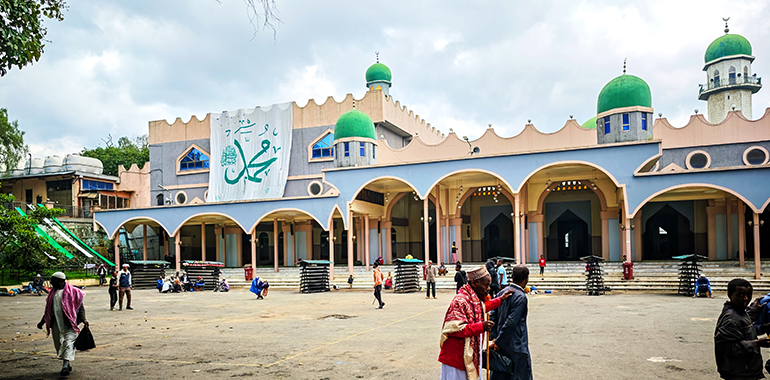
Today, Ethiopia is one of the most populous countries in Africa, with an estimated population of around 120 million. According to official figures, approximately 35–40 percent of the population is Muslim. However, unofficial sources suggest that this ratio may be as high as 60 percent. The Muslim population is concentrated primarily in the eastern parts of the country, particularly in the Somali Region, Afar Region, and Harar areas. There is also a significant Muslim community in the capital city, Addis Ababa. In Harar, Muslims continue to preserve a deeply rooted Islamic culture in Ethiopia. Harar is known as the “Fourth Holy City of Africa,” and it is home to centuriesold mosques, tekkes, and madrasahs. Another feature that gives Harar particular significance from the perspective of Türkiye is that it was the city where the Ottoman Empire opened its first consulate in Africa during the Ottoman period. The consulate building was restored by the Turkish Cooperation and Coordination Agency (TİKA) and transferred to the Maarif Foundation, and it currently hosts educational activities. The city is surrounded by walls, and the five entrance gates, symbolizing the five pillars of Islam, still exist today. Today, although Islam is not the official state religion in Ethiopia, it constitutes an important element of social life. Muslims are able to establish their own religious institutions, educational centers, and civil society organizations. The Ethiopian Supreme Council of Islamic Affairs coordinates religious activities as the official representative body of Muslims in the country. In addition, with the support of Türkiye, Qatar, Saudi Arabia, Morocco, and several other countries, numerous mosques, Qur’an courses, and charitable initiatives are being established and sustained.
Education and religious institutions
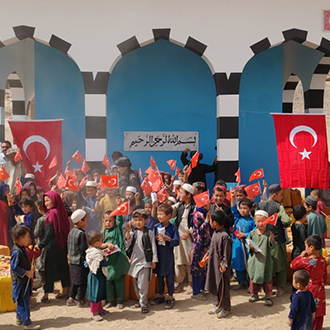
Islamic education in Ethiopia has developed across a broad spectrum, ranging from traditional madrasahs and mosques to private Islamic schools. Particularly in recent years, there has been a significant revival in the field of Qur’an education. Hifz centers for both male and female students have been established in cities such as Harar, Dire Dawa, Jijiga, and Addis Ababa. In addition, private institutes offering instruction in Islamic sciences, the Arabic language, and hadith studies are actively operating. Since the early 2000s, the Türkiye Diyanet Foundation has been renovating mosques and educational institutions throughout Ethiopia, while also working to enhance the religious awareness of the local population. Through the water wells it has constructed in various regions of the country, its proxy sacrificial offerings (qurban) program, food package distributions during the month of Ramadan, projects aimed at empowering orphan families, the construction of madrasahs, and humanitarian assistance provided to refugee camps, the Foundation has made substantial contributions to the strengthening of both religious life and social solidarity.
In recent years, efforts have been undertaken to revive many sacred sites and structures that left a lasting mark on Islamic history. Within this framework, the tomb of Najashi, who welcomed the Companions that migrated to Abyssinia upon the command of the Prophet Muhammad (saw), as well as the graves of fourteen of the noble companions, were restored and opened to visitors by TİKA.
Social life and Islamic identity
Among Ethiopian Muslims, religious occasions such as the month of Ramadan, Eid al-Adha, and Mawlid al-Nabi are celebrated with great enthusiasm, and these days are officially recognized by the state as public holidays in Ethiopia. Mosques function not only as places of worship but also as centers of social solidarity. The participation of Muslim women in social life is also steadily increasing, with women assuming active roles in education and charitable activities. The presence of Islam in Ethiopia also stands as a powerful example of the possibility of different religions coexisting side by side. Although certain periods of tension have occurred throughout history between Muslims and Christians in the country, an overall atmosphere of mutual respect and peace has generally been maintained. Despite processes such as modernization, urbanization, and globalization, Islamic values continue to shape the country’s spiritual fabric and instill hope in future generations.