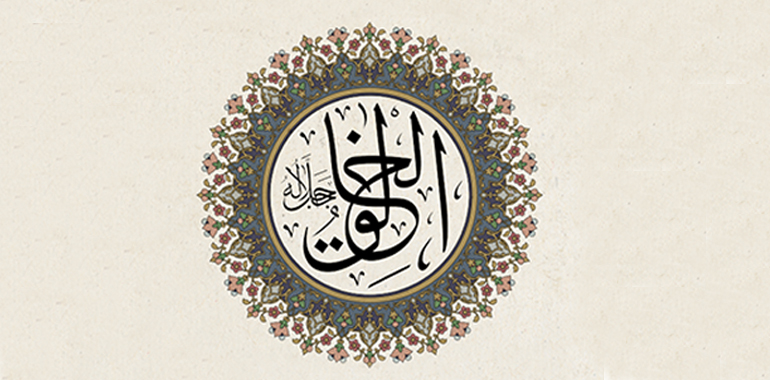
The One Who creates everything in due measure and with precise determination... The One Who establishes a matchless order without allowing anything to transgress its bounds or infringe upon another... The One Who, when the time comes, manifests Himself through His Divine Names to the beings that await their turn in draft form in His presence— giving them life with His command “kun” and bringing them forth from nonexistence, the greatest affliction, into existence, the foremost of blessings... Since al-Khaliq refers to the One Who determines and defines the existence of all things, along with the states they will experience throughout their existence, it is thus a name that encompasses both determination (taqdir) and bringing into being (ijad). Accordingly, al-Khaliq is “the One Who creates in a deliberate, conscious, and harmonious manner, according to a purpose and plan”. In this sense, this name serves, on one hand, to protect a person from associating divinity with other beings who have no power to create anything— namely, from shirk; and on the other hand, it facilitates contentment with everything that exists by the decree of Allah the Almighty. Knowing that the existence of anything depends solely on His act of creation makes it easier to be content with what is brought into being contrary to our desires when the things we strive for do not come into existence. It encourages us to perceive the order and purposeful design in creation. By informing us that every act of Allah is according to a precise measure and calculation, it warns against opposing that divine order—lest one fall into the danger of wasting one’s existence.
In the Qur’an, Allah the Almighty’s attribute of being “al-Khaliq” is presented as one of the most significant pieces of evidence of His Lordship (Rububiyyah) (Zumar, 39:62; Ghafir, 40:62; Fatir, 35:3). As a consequence of His having created all things, servitude should be directed to Him alone (An‘am, 6:102); yet it is questioned with astonishment why worship is offered to those who have no power whatsoever to create anything (Ra‘d, 13:16). According to the Qur’an as well, the act of creation is not something that has been completed once and for all. Rather, He continuously creates at every moment (Rahman, 55:29; Nahl, 16:8, etc.). There are other Divine Names that emphasize various aspects of our Lord’s creative power, such as al-Bariʼ, al-Musawwir, al-Muhyi, al-Mubdiʼ, and al-Badiʻ. In Surah al-Hashr, where seventeen Divine Names are mentioned consecutively, the Names al-Khaliq, al-Bariʼ, and al Musawwir are mentioned in succession, pointing to the three successive stages of creation.
The name al-Hallaq, which appears in verse 86 of Surah al-Hijr and verse 81 of Surah Ya-Sin, also expresses that our Lord is the One Who creates continuously and perfectly. Realizing Allah the Almighty’s unique creative power, and that He does not cease after creating once but continually brings His creation into renewed existence, places a person in a constant state of gratitude. Indeed, even setting aside the ongoing act of creation in the cosmos, merely imagining what would happen if our bodies, minds, or consciousness were to fall outside the flow of uninterrupted creation for even a moment is enough to make one a grateful servant. Unlike bringing something into existence from nonexistence, creation sometimes takes place from an existing primary substance. For example, the creation of the Prophet Adam from clay and the creation of human progeny from a drop of fluid (nutfah) are of this kind. In this sense, creative power is also mentioned in the Qur’an in reference to the miracle of the Prophet Isa, who formed a bird from clay. This event is described in Al-i ‘Imran (3:49) and Ma’idah (5:110), where the term “khalq” (creation) is utilized. In this context, it has been understood to mean shaping an existing substance into a new form. In fact, the act of creation (khalq) attributed to the Prophet Isa is consistently qualified in the verses by the phrase “by Allah’s will,” thereby setting clear limits on its scope. The phrase “ahsan al-khaliqin” (“the best of creators”), which appears in two verses of the Qur’an, also indicates that the ability to create from existing materials is a capacity granted by Allah to His servants. Based on these two Qur’anic examples, al-Ghazali states that creation may be attributed to human beings in a metaphorical sense. This is because Allah has endowed them with the foundational faculties of creation: knowledge and power. In today’s world, where the value of creative abilities in human beings is gaining increasing importance across all areas of life, one of our most vital social responsibilities in the education of young minds is to help them fully develop this Divine gift bestowed upon us by our Lord, by seeking refuge in Him, and to free them from the influence of narrow minded attitudes that view creative intelligence as a threat. According to Ibn Arabi, just as a person requires the manifestation of this Divine Name in order to make sound decisions, they must also possess the attribute of creativity in order to maintain balance in their life of servitude and to persevere in their struggle against the nafs, Satan, and society. The invention and manifestation of beings that have originated in Allah’s knowledge in the most perfect manner, in the most beautiful form, and in a unique position, by human hands, also occur through the manifestation of this Divine Name. We perceive this form of creativity in the products of various branches of art and science. Regardless of how extraordinary the resulting work may be, if one becomes neglectful of the fact that both the materials employed and the intellect and capacities that transform them are endowments from the True Creator, the conditions for shirk begin to manifest.
Those who truly understand this Divine Name are always productive. They seek paths from what has been given toward what has not yet been given, and by combining their share of knowledge, power, and wisdom with their creative abilities, they produce countless works. In doing so, they do not act randomly or haphazardly. Every word they speak and every action they take is thoughtful, measured, carefully considered, and placed exactly where it belongs. Just as khilqat (creation) emphasizes the measure and harmony in our creation, akhlaq (morality), derived from the same root, expresses the balance and proportion within human character. In this sense, “to be moral” is to consciously reflect, through our actions, the harmony and beauty that our Lord has placed within our creation.