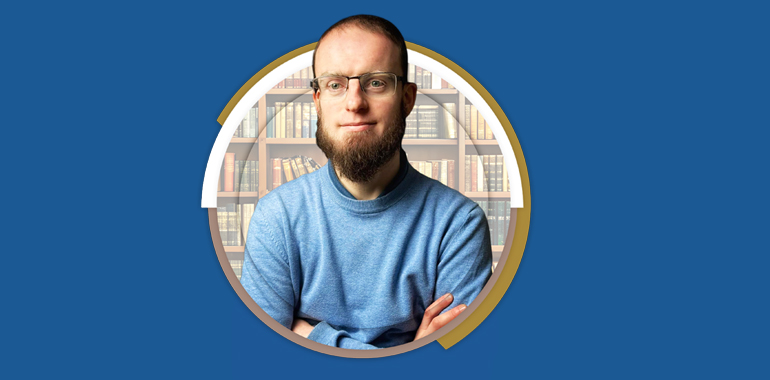
Thomas Sibille is a French bookseller, publisher, and entrepreneur who was born into a Catholic family. Inspired by a comparative reading of the Bible and the Qur’an, he converted to Islam in 2002. Aiming to help Muslims understand and fully embrace Islam, he founded the Al Bayyinah bookstore in 2008 and the Heritage publishing house in 2021.
Could you briefly tell us about yourself? When did you begin to question your beliefs? Was there a particular moment or experience that triggered this process?
My name is Thomas Sibille. I was born into a Catholic family. My father was responsible for organizing and leading activities in the place of worship, and my mother taught catechism. Faith has always been extremely important in my life. I prayed regularly, especially at night before going to sleep. Around the age of 18, I began to question certain aspects of my faith because of a passage from the Gospel that deeply struck me. I started researching the meaning of the word ‘paraclete’ as it is used in the Gospel of John. I consulted books of exegesis and learned that Paraclete refers to the Holy Spirit. However, in the biblical text, it says, “It is necessary that I leave so that he may come.” Yet the Holy Spirit had already come before. So, the explanation did not seem convincing to me. I discussed this with my father, who confirmed that it referred to the Holy Spirit, but I was still not satisfied. I then searched online and discovered that Muslims say that the Paraclete means “Ahmad,” the name by which Muhammad is referred to in the Qur’an in connection with the biblical reference to him. That was when I began to take an interest in Islam, a religion I knew almost nothing about, since I did not have any Muslim friends. I discovered that Muslims believe in Jesus, believe in Moses, believe in Abraham, and recognize all the prophets. This was something entirely new to me, because for me, believing in Allah was like believing in Buddha — it seemed like a completely different god. I came to realize that Muslims believe in the same God I believed in and recognize the same prophets, but they say that Jesus is a prophet and not the Son of God. I then decided to obtain a copy of the Qur’an. Every evening, I would read one page of the Qur’an and one page of the Bible. As I continued my readings, I began to see that the Bible pointed in the same direction as the Qur’an, toward monotheism. I noticed that the Trinity is not explicitly mentioned in the Bible and that Jesus consistently presents himself as a human being and a prophet, never as God or the Son of God. After some time, I stopped praying to Jesus and began praying to God alone. I became convinced of pure monotheism. But I still needed to determine whether Muhammad was truly a prophet. To answer that question, I read a biography written by a French Muslim convert named Étienne Dinet. When I discovered the life of the Prophet, I was deeply moved. At that point, I wanted to convert to Islam. I hesitated for a few months because I was afraid of the unknown and worried that my parents might resent me. But eventually, I took the step, and I became a Muslim in January 2002.
How did you first encounter Islam? At that time, what was your level of knowledge and perception of Islam?
I had absolutely no knowledge of Islam. My perception was neither negative nor positive. I did not have any Muslim friends. I respected Muslims, but I knew nothing about their religion and had no particular interest in it. When, through reading the Bible, I turned to the Qur’an, I was amazed by the beauty of Islam. As someone who was already a believer, my faith grew even stronger when I discovered and truly understood pure monotheism. The awareness of monotheism deepened my conviction in a way I had never experienced before. And the happiness I found in prayer is a happiness I had never known previously in Christianity.
After this decision, how did your family and close circle react? What kinds of changes or transformations did you observe in these relationships over time?
When I decided to convert to Islam, at first, I did not tell my parents because I was afraid of their reaction. After a few months, I could no longer keep it a secret, and I told them. Their reaction was very harsh. They told me that by doing this, I had broken family ties, and they gave me a few months to leave the family home. I then had to move out. For several months, I was hosted sometimes by one friend, sometimes by another, and at times I even slept in my car. Despite what might appear from the outside as a very difficult period, it was, in a way, a beautiful time. My faith was at its strongest. I discovered the tranquility of the believer, the gatherings of Muslims, all generous and brotherly with one another, and the joy of going to the mosque. I gradually grew in my religious practice. At the same time, I always sought to maintain good relations with my parents, since Islam requires preserving family ties. For ten years, my parents turned their backs on me. But after those ten years, they finally came to respect my choice. Since then, we have had a very good relationship, and we see each other regularly. It was very difficult for them. And now that I am a father myself, I fully understand how hard it must have been for them to face such a decision from their son.
How did the idea of establishing your bookstore in Paris come about? For you, is this space merely a bookstore, or does it represent a broader cultural mission?
When I converted to Islam, I developed a deep passion for reading because I wanted to learn more about the religion. At that time, there was no Muslim bookstore in the suburbs of Paris. The only ones were located in Paris itself. I used to go there very often, but I was saddened to see that people living in workingclass neighborhoods did not have access to information or to books. So, together with two friends, we decided to open a Muslim bookstore in order to give Muslims a better understand their religion. Through this project, I feel invested not merely with the role of a businessman, but with a cultural mission. The objective of this bookstore is to help Muslims acquire a comprehensive vision of Islam, to know Islam in its entirety. Through reading, our minds can open, our way of thinking can become sound, and our actions can become righteous.
In order to provide Muslims with the tools to understand the world, we have expanded our selection beyond purely religious books. We also offer books on history, sociology, and various other subjects. The goal is to guide Muslims in their intellectual development so that they are not merely shaped by algorithms or influenced by social media, but become thinking individuals capable of independent reflection.
In your opinion, how influential are media, publishing, and cultural production in shaping or transforming the perception of Islam in the West?
Books, bookstores, and culture are among the most powerful means of transforming society. They encourage individuals to think, to reflect, to build connections with one another, to create bridges between communities, and ultimately to generate peace. Reading is not like screens or videos. It does not primarily stimulate emotion; rather, it develops reflection. It requires time, depth, and intellectual engagement. When we first opened the bookstore, we simply offered the books that were available on the market, without truly considering their impact. But as we gradually became more aware of the importance of books and their influence, we began to be more selective. We chose works that help Muslims better understand Islam in a balanced way, encouraging openness and tolerance. At the same time, we selected books that allow non-Muslims to discover the beauty and gentleness of Islam. To support this mission, we regularly organize literary evenings, discussions with authors, and gatherings on a wide range of topics. These events allow Muslims and non-Muslims to meet around books, to exchange ideas, and to get to know one another. Even if the media sometimes conveys a negative image of Islam, everyday actions and local cultural initiatives — through history, literature, and dialogue — can change perceptions. They help Muslims avoid withdrawing into themselves out of fear or isolation, and instead encourage them to engage confidently and positively with society. At the same time, they give those who are not Muslim the opportunity to meet Muslims in real life and to discover, through books, the greatness of Islamic civilization. In doing so, people can come to understand that Islam has illuminated humanity and profoundly influenced the Western world.
Finally, based on your own experience, what would you like to say to people who have recently encountered Islam or are considering embracing it?
Based on my own experience, I would advise those who have embraced Islam to practice moderation. Islam is not a sprint; it is a lifelong journey. Reading and knowledge are essential. Rather than looking to group and ideological leaders to follow blindly, one should nourish oneself with the ideas of Islam and continually engage with other ideas found in books. A Muslim should always remember that wherever he or she is, they must shine through their character. They must be a source of goodness in society. They should never withdraw into isolation. No matter how difficult relationships may be — with parents, neighbors, or friends — a Muslim should remain smiling, welcoming, and always extend a hand toward others. I also advise those who have converted, or who are considering conversion, to show great patience and understanding toward others. If today Islam sometimes has a negative image because of media portrayals or the behavior of certain Muslims, then one must be even more patient, even more resilient, and make even greater efforts through personal conduct to help others recognize the true value of Islam. Islam is a beautiful religion. It is a religion of civilization, of positive change, of blessing — not a religion of harshness, withdrawal, or isolation. A person who embraces Islam should be aware that becoming Muslim and recognizing Islam as the truth is a gift from God. Moreover, that gift should lead them to gratitude toward God, and to kindness and mercy toward others who have not yet received that same gift.