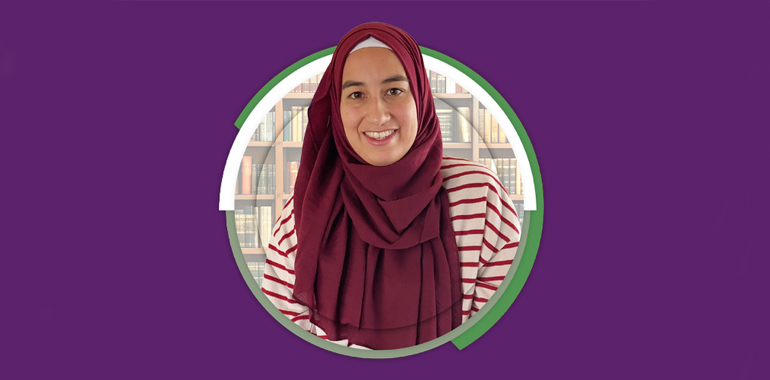
Daniela Uruena Garcia is from Colombia and has been Muslim for 14 years. She studied psychology, and also studied industrial design in Colombia, and received a master’s in counselling psychology in Türkiye, where she has lived for five years. She translates books from English and Turkish to Spanish.
I’m from Colombia. I’ve been Muslim for 14 years now. I live in Türkiye. I studied psychology, and I also studied industrial design in Colombia. When I came to Türkiye, I did a master’s in counselling psychology, alhamdulillah, and I am the only child. As well, I’m the only Muslim in my family. My parents are in Colombia. I’m working in the Presidency of Religious Affairs as a translator. I translate Islamic books from English and Turkish to Spanish, alhamdulillah.
In Colombia, most of the people are Catholic Christians. In my whole life, I studied in a Catholic school. My parents are Catholic, so I always believed in God, for sure. I believe then that this was something superior, and we prayed to the angels and to Jesus. So I did have a belief. I became Muslim when I was 22 years old. After Islam, everything changed alhamdulillah. I think somehow belief starts to grow in your heart. Islam gives you hope. If you are a believer, the most important thing as a Muslim is to have hope. Never lose hope, that is what Islam teaches me.
I was traveling to graduate from the university, so for that reason, I had to go to America to get my English certificate. I was in the States for three months. I liked the English course, and it was the first time that I met Muslims. In fact, it was the first time that I saw a Muslim. I don’t remember that I learned anything about Islam specifically, but I remember I saw a girl, my classmate, and she was wearing a beautiful headscarf. It was summer, it was really hot, but she was still wearing a headscarf, and I got curious about it. It was the first time that I crossed paths with Islam, as I had never heard anything about it in my life.
The first question I asked her was, “Why are you wearing this?” Since she was married, I thought her husband probably made her wear it. She was 24 years old. However, she told me, “No, my husband doesn’t force me to do anything; it is my choice. It’s just because it helps me that people will identify me as a Muslim, you know. In the Qur’an, Allah says that women should cover themselves for protection and to self-value. She said: “Our beauty is not for everybody. In that way, people will value you, but it is not for your beauty. It is for your personality and for who you are. So we have to protect that beauty, and we have to share it with the right people. So to say, I share with my family, with my husband, with my sons, but not with everybody. I’m special. Allah says that women are special and we have to protect them.” When I was learning English, she was learning English. Sometimes she used to talk in Arabic. I used to speak in English. She used to say inshallah and alhamdulillah. For example, I was sneezing and she said alhamdulillah. When she was starting something, she says bismillah. When I said something, she said mashallah, inshallah. I said, “What is Allah?” She said: “Allah is God, and it’s the same, but in Arabic, Allah is used only for Him. This word is just for Him because Allah is not a woman, nor a man. We do everything for Allah, and we praise Him all the time. We give up things for Him, we ask for His forgiveness all the time, for Allah is present.” At the same time, I thought to myself that she was really happy. She was studying, then she would go back to Saudi Arabia. She will work, and she is free. However, we have the opposite thinking that a Muslim woman doesn’t have advantages, but that she is disadvantaged. The thought is that she is controlled by her husband, she will have to stay at home, and she will not be able to do anything at all. But this is culture, not Islam. At the same time, they believe that Allah is with them all the time. Even during a bad situation, they would say alhamdulillah. For example, sometimes they didn’t have money or other things, but they didn’t complain. I was very pleased with that response.
In this process, how did you decide to be a Muslim?
I have never said, “I want to be Muslim”. But now that I think about it, I feel Allah was showing me the way. He takes you from here to there, and Allah is the best planner. After I came back from the States, I started to read about Islam in my own language. I didn’t find much. I used to search on the internet, but there wasn’t much information in Spanish. Everything was in English, and my English wasn’t that good. But I found out that it was really logical. I understood and believed that Allah is One. I believed that Jesus is a prophet, and that Allah sent him to guide us. I didn’t have any issue with the belief. I said, “Okay, I accept the angels, the divine books, destiny…” The beliefs were not much different from Catholicism and Christianity. The problem was society, how I was going to behave in my society. I come from a social environment where everything is mixed, and the morals are not well balanced. So I thought, “I have to wear hijab… How is that going to work? Who will I marry?” I was thinking about these kinds of things. But I kept reading. One day during Easter, my parents went on a trip. I didn’t go; I stayed home, and I said to myself, “Okay, I’ll go to a masjid”. But this is Colombia. I live in the capital, Bogotá. I looked on the internet and found that there was a mosque close to my house, somehow. I went there. Since it was a holiday, the streets were empty. No one was outside. I followed the address and went to the neighbourhood. I was walking, expecting a big mosque with everything. But I didn’t find anything like that. I said to myself, “Okay, I’ll go back home.” But something inside me said, “Don’t go. Go back again. Just try once more.” So I went around again. I was in the area near the Palestinian Embassy. There are old houses, I said, “Okay, let me try here, behind the embassy.” I rang the bell. A brother opened the door. I said, “I’m looking for the masjid.” They were repainting and repairing the mosque, so they had taken down the sign — the name wasn’t there. He said, “Yes, this is the mosque. Let me call a sister.” He called a sister, who was Colombian, also a convert. We spoke in our own language. She gave me some brochures. I told her I had already accepted the beliefs, but I didn’t know how to behave now. I didn’t know how my family would accept it, how my friends would react, or how I would grow into it. She said, “Come tomorrow, it’s Friday, so there will be Jumah prayer. You’ll see many sisters. We also share food. Come tomorrow, read books, and it’s okay.”
The next day, I went to the Jumah prayer. The prayer was in Arabic and Spanish. After prayer, it was lunchtime, so they shared food. I talked to the sisters, most of whom were Colombians, and they were really nice. We had coffee, snacks, and I felt comfortable. Then I went to talk to the imam of the mosque. I asked him the same questions. He said, “You are ready.” I said, “Ready for what?” He said, “Do you believe in God? Do you believe in the Prophets? In the angels? In the Books? In destiny?” I said, “Yes. Catholics believe the same. There’s no difference”. He said, “Then you are ready.” I said, “I’m not ready.” He said, “What if you go outside today and — may Allah protect you — you have an accident and you die? Where do you want to go? To Paradise? Or to Hell?” Then he wrote something on a piece of paper and said, “Let’s go to the women’s area.”
We went to the women’s section. There were a few sisters. We sat in a circle. I was in the middle, and he was in front of me. He gave a speech and then said: “Now you’re going to repeat after me.” I said, “Okay.” So I said the Shahadah. Then everyone said: “Allahu Akbar!” I wasn’t really conscious of what it meant. I didn’t go there to say, “I want to be Muslim” or “I want to make Shahadah”. He made me do it. I didn’t think about what would happen the next day. I just said it. Alhamdulillah. He gave me a book and told me the prayer times, how to do ghusl when I get home, and that I’m welcome every Friday. He said: “Don’t worry. Allah is with you.” I went out. The street was empty. I looked to the right, then to the left, but no one. I thought: “Nobody knows. Let me try. If I like it, I’ll continue. If not, I’ll drop it. It doesn’t matter.” I took a taxi and went back home. I messaged my Muslim friends and told them, “I think I’m Muslim.” They said, “What do you mean, you think?” I explained everything. One of them said, “My sister, you are Muslim”. She said to me: “Just take it easy. If you need anything, I’m here. You can text me whenever. You’re a Muslim. We are sisters in Islam. Don’t worry, Allah will guide you.” I said, “Okay, nice. I won’t worry.” That made me feel better. After that, every Friday I used to go to the Masjid because it was on the way to my university. I would stop by, spend time with the sisters, and learn more.
One day, I was walking my dog around the neighborhood, and I saw a woman in a hijab and a little boy in a jubba. I asked them, “What is this place?” She told me it was an Islamic center called Al-Kurtubi. They offered classes on the weekends for Muslims and non-Muslims about Islam, Arabic, and related topics. I started going every weekend. There were also Colombian Muslims there, and I started learning Arabic. I learned how to pray on time, how to wear hijab, what halal food is — and it was just 10 minutes from my house. It was really nice. When I was there, I felt like I was in another world. I was sharing time with my Muslim friends. Many of my best friends, who are also in Türkiye, I met there. I was happy, but when I went back home, I felt a heavy energy. Nobody understood me there. I felt like an alien, but every weekend I felt happy. Before this event, I had dropped out of university in my last semester, and my father thought I had gone mad. But after I became Muslim, I returned to finish my degree. Allah opened the doors for me and wrote my thesis. Over time, I began to feel better. Then Ramadan came. I knew I had to fast, and my parents would definitely notice. I was really scared. I went to the same imam who helped me take my Shahadah, and I asked, “How do I tell my parents? I’m really scared. How will they react?” He said, “Just say Bismillah.” I said, “How?” and he said again, “Just say Bismillah and say it.” So I said okay. One weekend, I approached my father. He was sitting in the living room reading the newspaper, very relaxed. I felt like a little girl, nervous. I said, “Dad… you know I’ve been going to this place on weekends, and there are really nice people. I’ve been learning Arabic, and they teach about a religion called Islam. I really liked it, and I became Muslim. Now there’s a month where we fast, it’s called Ramadan, so I’ll be fasting.” He didn’t really react. He said, “Are you happy with that?” I said, “I’m really happy.” He said, “Okay.” That was it. He didn’t say anything else. Then I told my mom. It was the same. I said, “I’ve been going to this place, I like it, I became Muslim, and I’m happy with it.” She didn’t say anything. Maybe they didn’t realize it was a big deal. I hadn’t changed much. I didn’t wear a hijab. My behavior was the same. My friends were the same. I hadn’t started praying openly either; I used to pray all my prayers at Isha time, “aerobics style,” all at once. They didn’t see any change. Also, I had kept in touch with my Muslim friends and introduced them to my mom, so she probably thought it was just a phase. Like, “Oh, Daniela is just trying something new, she’ll drop it.” But after 14 years, I haven’t dropped it.