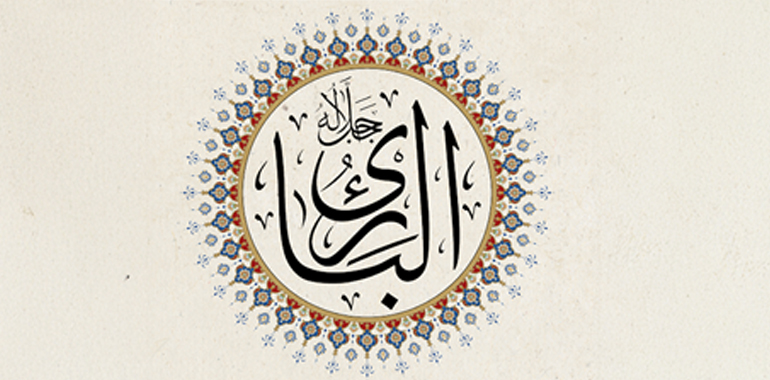
From the smallest particle to the largest sphere, the astonishing perfection of the magnificence inherent in the very structure of every single being within the created universe, and the order and harmony manifested in the ceaseless flow and motion of these innumerable individuals— all known and unknown forms of existence— moving in perfect accord with one another… He is al-Bari’ Who brings this entire system into existence from nothing, without the need for any example or model. In the final verses of Surah al-Hashr, wherein fifteen of the Asma al-Husna are mentioned, the names al-Khaliq, al-Bari’, and al-Musawwir are cited consecutively. The name al-Khaliq signifies the One Who measures, determines, and ordains with precise calculation before bringing creation into existence. It denotes determining the proportions, limits, and decrees of all things before their actual creation. Al-Bari’, in accordance with this measurement and determination, refers to the One Who brings into existence—especially living beings—from nothing, without relying upon any model to observe or imitate. There are differing scholarly opinions regarding the root from which this name is derived. According to each of these possibilities, it has acquired distinct shades of meaning and thus possesses a rich semantic depth. As a result of this richness, the name al-Bari’ conveys meanings such as: the One Who creates; the One Who invents beings without any foundational substance or pre-existing model; the One Who is utterly free from being created Himself; the One Who brings all entities in the universe into existence in perfect harmony and order despite their many differences; and the One Who is under no obligation or liability, bestowing whatever He gives purely as an act of grace. Accordingly, the entirety of these unique stages of design and creation—and the continuing bestowals and favors that follow—are all from the grace of our Lord. No person and no power can compel Him to do or not to do anything; yet He has prescribed mercy, grace, and beneficence upon Himself (An‘am, 6:12). Our Lord, through His knowledge and power— whose true extent the human being is incapable of comprehending— designed the realm of existence, and thereafter brought it into being with a unique act of creation, without looking to any model, in accordance with the measure and order determined within that design. Just as all the elements constituting the existence of each created being have been fashioned in harmony with one another to ensure its continuation, so too—despite the immense differences among them—the functions and benefits that all beings perform within the universe have been created in accordance with a universal harmony.
So much so that it is as though, within the cosmos, everything exists for one thing, and one thing exists for everything. Observing this magnificent harmony and order within the universe guides us to establish a reflection of that same harmony in our own affairs. Just as every being in the cosmos has been designed and created in such a manner as to contribute—both to its own continuity and to the orderly persistence of the entire universe, near and far—so too must servants, as a part of this realm of existence, design their relationship with the Creator, with themselves, and with other created beings in a way that does not transgress this order, lest they fall into existential confusion and distress. This order must be observed not only in ontological relationships, but even in the most ordinary organizations of daily life. The scattering of goals leads to the scattering of actions, and that in turn results in arriving nowhere in life.
By taking this law of creation as an example, human beings must utilize all the qualities bestowed upon them in their proper place and in accordance with their intended purpose, and must not squander themselves and their potential by straying beyond the aim of their creation. In the Surah al- Baqarah (2:54), it is related how the Children of Israel wronged themselves by setting up the calf statue as a deity in place of Allah. They are called to repent to the true Creator, and in contrast to their imagined, conjectural notion of a creator, emphasis is placed upon the unique and flawless creation of Allah the Almighty. In this context, Allah the Almighty refers to His own Essence with the name al-Bari’. For those who know the Names of our Lord to the extent of their capacity and believe in them in accordance with the meanings they contain, two fundamental outcomes arise: On the one hand, this knowledge and faith protect them from falling into false assumptions about Allah and from the danger of associating partners with Him (shirk). On the other hand, by adorning them with the character traits required by these names, they cultivate and enrich the believers’ character, and assist them in attaining a state that is pleasing to Allah the Almighty. Thus, sincere faith and complete submission to the divine name al-Bāri’ in all its dimensions safeguard the believer from the misconception that any being other than Allah possesses the power of creation ex nihilo, and from falling into servitude to created entities. On the other hand, it keeps alive within their consciousness the awareness that the true Creator of every event that occurs in the universe is Allah. It frees them from being negatively overwhelmed by events and from falling into excessive sorrow. At the same time, those who are adorned with the character required by this name do not become blind imitators in their own affairs, nor do they become captives of their surroundings; rather, through their perspective, interpretations, and manner of conduct, they consistently succeed in finding new paths. According to Ibn ‘Arabi, by virtue of this name, the believing servant not only becomes free from being controlled by beings and events, but moreover becomes one who guides others in accordance with the will of his Lord.